
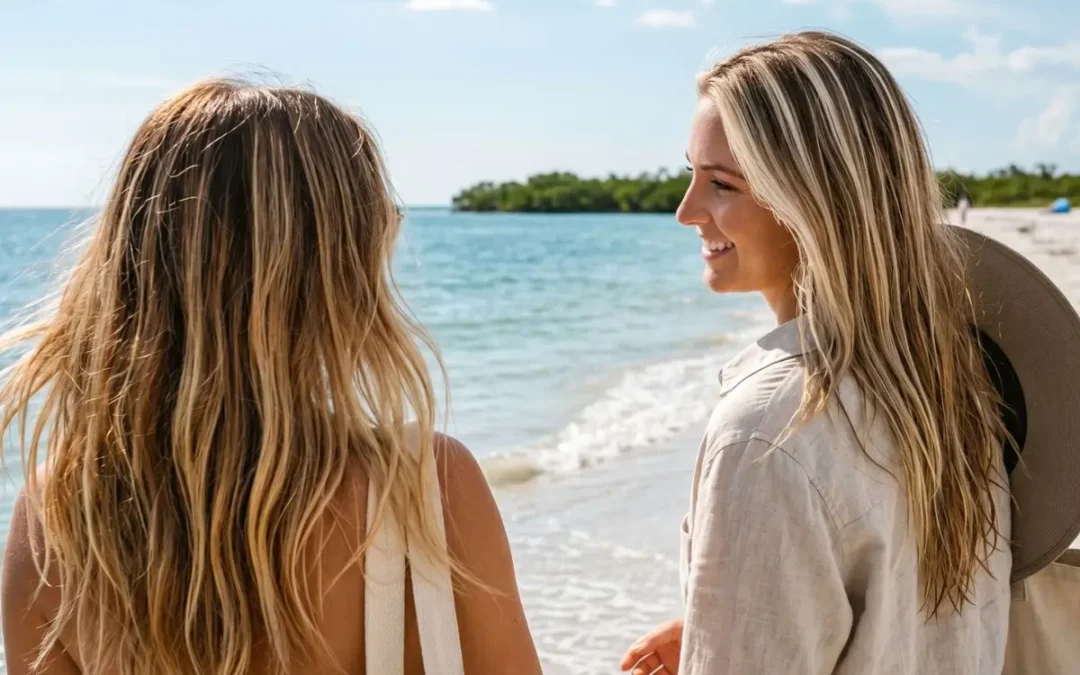
It is one of the most common questions we hear at Kate’s Kuts: “Should I get balayage or highlights before summer?” Both techniques can look stunning. Both can be executed beautifully by a skilled colorist. But in Southwest Florida, the answer to that question is not just about aesthetics — it is about how your color will perform against 90% humidity, daily UV exposure, saltwater from the Gulf, and the mineral-rich water coming out of your shower.
After more than a decade of doing color in Bonita Springs, we have seen both techniques thrive and struggle in this climate. This guide gives you the honest breakdown so you can make the right choice for your lifestyle.
Understanding the Two Techniques
Before comparing how they perform in Florida, it helps to understand what makes balayage and traditional highlights structurally different.
Traditional highlights are applied using foils. The colorist sections the hair, applies lightener to precise sections, wraps them in foil, and processes them to a consistent level of lift. The result is a uniform, high-contrast look with a defined root line. Because the lightener is applied close to the scalp, regrowth becomes visible relatively quickly — typically within four to six weeks.
Balayage is a freehand painting technique. The colorist sweeps lightener onto the mid-lengths and ends of the hair, creating a gradual, sun-kissed transition from the natural root color. Because there is no defined root line, regrowth is far less noticeable. Most balayage clients can go twelve to sixteen weeks between appointments without the color looking grown out.
Both techniques require bleach or high-lift color to achieve the lightened sections, which means both open the hair cuticle during the process. This is the critical detail when it comes to Florida’s climate.
How Florida’s Climate Affects Each Technique
UV Exposure
Florida’s UV index regularly reaches 10 or above during summer months — classified as “very high” to “extreme” by the Environmental Protection Agency. UV radiation breaks down the melanin in lightened hair, causing it to fade and shift in tone. [1] Blonde highlights can turn brassy or yellow. Balayage, because it tends to be applied at a slightly warmer, more natural tone to begin with, often ages more gracefully under UV exposure than a stark, cool-toned highlight.
The practical difference: highlights may require a toning gloss or toner refresh more frequently during summer. Balayage’s warmer, blended tones tend to fade more naturally and require fewer corrective appointments.
Saltwater and Chlorine
Both saltwater and chlorine are oxidizing agents. They lift the cuticle, strip color molecules from the cortex, and leave hair dry and porous. [2] The effect is the same regardless of whether you have highlights or balayage — but the visual impact differs. Because highlights create a high-contrast look, any fading or brassiness is immediately obvious against the darker root. Balayage’s gradual blend means the same degree of fading is far less noticeable.
Hard Water Mineral Buildup
Southwest Florida’s water supply draws from the Floridan Aquifer, which is naturally high in calcium and magnesium. These minerals deposit on the hair shaft with every wash, and they interact with hair color in a specific way: calcium buildup creates a film over the hair that blocks toner from absorbing evenly, causes blonde to shift toward a dull, greenish-gray, and makes color look flat rather than luminous. [3]
This affects both techniques equally, but again, the visual impact is more pronounced with high-contrast highlights where any unevenness in tone is immediately visible. For a full explanation of what hard water does to color and how to treat it, read our deep dive: Hard Water and Your Hair: How Southwest Florida Water Affects Your Color.
The Maintenance Comparison
| Factor | Traditional Highlights | Balayage |
|---|---|---|
| Regrowth visibility | Noticeable at 4–6 weeks | Minimal at 12–16 weeks |
| UV fading | More visible (high contrast) | Less visible (blended tones) |
| Saltwater/chlorine impact | Fading more apparent | Fading blends more naturally |
| Hard water brassiness | Very visible against root | Less visible in blend |
| Appointments per year | 6–8 | 3–4 |
| Cost per year (approx.) | Higher due to frequency | Lower due to fewer visits |
| Best for | Clients who want precision, high contrast | Clients with active outdoor lifestyles |
Which One Is Right for You?
The honest answer is that balayage is generally the more forgiving technique for an active Southwest Florida lifestyle. Its gradual grow-out, blended tones, and lower maintenance frequency make it better suited to clients who spend significant time outdoors, near the water, or who want to extend the time between salon visits.
That said, traditional highlights are not the wrong choice — they are simply a higher-maintenance commitment in this climate. If you love the crisp, high-contrast look of foil highlights and you are willing to come in for a toning gloss every eight to ten weeks, highlights can look absolutely stunning year-round. The key is protecting your investment properly.
Protecting Your Color: What Every Florida Client Should Do
Regardless of which technique you choose, the following steps will meaningfully extend the life of your color in the SWFL climate.
Lock in the moisture. After any color service, your hair cuticle has been opened and is more porous than usual. A professional bond-building treatment (such as Olaplex or K18) applied at the salon and maintained at home helps reseal the cuticle and protect the color molecules inside. For a full breakdown of how to manage frizz and porosity in Florida’s humidity, see The Ultimate Guide to Beating Florida Frizz.
Fight the hard water. Use a chelating or clarifying shampoo once every two to four weeks to remove mineral buildup before it has a chance to dull your color. This single step can add weeks of vibrancy to any color service.
Use UV-protective products. A leave-in conditioner or styling product with UV filters is not optional in Florida — it is maintenance. Apply it every time you go outside, and reapply after swimming.
Rinse with cool water. Hot water opens the cuticle and accelerates color fading. Rinsing with cool or lukewarm water after shampooing helps keep the cuticle sealed and the color locked in.
Book Your Color Consultation
The best way to determine which technique is right for your hair type, lifestyle, and color goals is to talk to a colorist who knows the SWFL climate. At Kate’s Kuts, every color service begins with a consultation so we can recommend the right technique, the right tones for Florida’s light, and the right maintenance plan to protect your investment.
Book Your Color Appointment at Kate’s Kuts Today and let us build a color strategy that works with the Florida climate, not against it.
References
[1] U.S. Environmental Protection Agency. (n.d.). UV Index Scale. https://www.epa.gov/sunsafety/uv-index-scale-0
[2] Gavazzoni Dias, M. F. (2015). Hair cosmetics: An overview. International Journal of Trichology, 7(1), 2–15. https://doi.org/10.4103/0974-7753.153450
[3] Central Florida Public Media. (2024). The battle between Central Florida’s hard water and your hair. https://www.cfpublic.org/2024-04-26/the-battle-between-central-floridas-hard-water-and-your-hair